
TCL vs Vizio TVs
Did you know about TCL vs Vizio TVs, if yes then this article is for you. We will be discussing. Read on for more.
When it comes to purchasing a new television, the quality of the picture is among the key aspects to take into account. However, the quality of a picture involves more than just resolution and color accuracy; viewing angles also play a role. This element is vital if you frequently watch TV with family or friends from various locations in the room, but many individuals fail to take it into account. TCL and Vizio are two well-known TV brands in the budget to midrange category that frequently arise in conversations. While both provide smart TVs with contemporary features, how do they stack up in terms of viewing angles? Let’s explore thoroughly.
Understanding Viewing Angles
Prior to the comparison of TCL and Vizio, it is crucial to grasp the meaning of “viewing angles.”
The term viewing angle denotes the range of positions from which a TV screen can be viewed without significant deterioration of the picture quality. The image usually appears perfect when you sit directly in front of the TV. However, when you shift to the side, the image may begin to fade, colors might become less vibrant, or contrast could diminish.
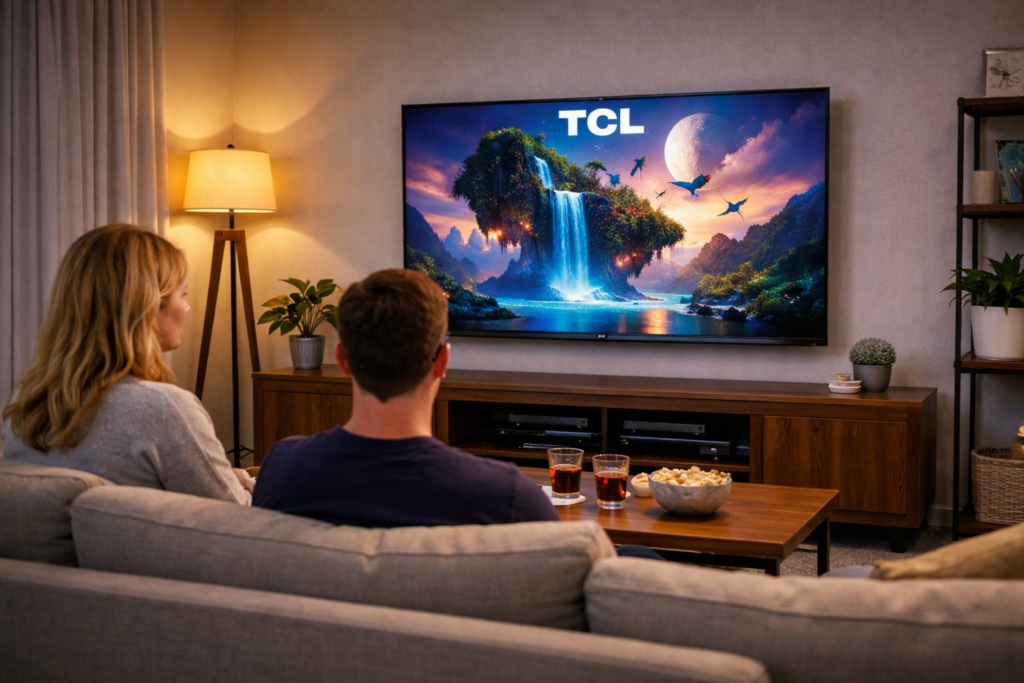
- Wide viewing angles: The quality of the image stays uniform even when viewed from the side.
- Limited viewing angles: When colors and contrast are viewed from an angle, they shift significantly.
In households with open living areas or wide seating arrangements, TVs that offer wider viewing angles are perfect.
TCL TVs and Viewing Angles
TCL has established itself as a key competitor in the budget and midrange TV market, particularly with its 4-Series, 5-Series, and 6-Series models.
Key Features Affecting Viewing Angles in TCL TVs
- Panel Type
In their 4K models, most TCL TVs are equipped with VA (Vertical Alignment) panels, while higher-end models may feature IPS (In-Plane Switching) panels.- VA panels:Outstanding contrast ratios, profound blacks, but limited viewing angles. If you view from the side, the image quality deteriorates.
- IPS panels: When viewed from the side, they provide wider viewing angles and more uniform colors, but in dim scenarios, black may take on a grayish hue.
- Local Dimming and HDR
Full-Array Local Dimming (FALD) is frequently included in TCL’s higher-end models. Although contrast and HDR performance are enhanced, viewing angles are not necessarily improved. Viewers who are off-center could still perceive changes in color or brightness. - Roku TV Integration
Roku OS, which provides an intuitive smart interface, powers the majority of TCL TVs. It improves the overall user experience but has no effect on viewing angles.
Viewing Angle Performance of TCL TVs
- TCL 4-Series (Budget Models):VA panels result in limited viewing angles. Side viewing will reveal reduced contrast and washed-out hues.
- TCL 5-Series (Midrange): Some IPS versions have somewhat greater angles, although VA panels are still the most common. Suitable for one or two observers seated in the middle.
- TCL 6-Series (High-End Models): Combines VA panels with superior contrast and HDR. From moderate angles, color reproduction is impressive, although viewing angles are still more constrained.
Verdict on TCL: Ideal for direct viewing. Not the best option for large seating arrangements unless you choose IPS-based devices, which are hard to come by.
Vizio TVs and Viewing Angles
Another well-known American company that sells TVs that frequently face off against TCL is Vizio. The Vizio M-Series, P-Series, and V-Series are popular models.
Key Features Affecting Viewing Angles in Vizio TVs
- Panel Type
Similar to TCL, Vizio’s M-Series and P-Series mostly feature VA panels, with a few IPS alternatives available for less expensive models.- VA panels provide high contrast but suffer off-axis.
- IPS panels (rare in Vizio) offer wider viewing angles but slightly lower contrast.
- SmartCast OS
SmartCast, a feature of Vizio TVs, enables casting and streaming. Its seamless interface improves the watching experience even if it has no effect on picture quality. - High-End Technologies
- P-Series Quantum TVs: Viewing angle problems may be somewhat mitigated by some models’ improved color and HDR capabilities.
- IQ Ultra and Pro models:Use quantum-dot technology to improve color saturation, although VA panels still limit viewing angles.
Viewing Angle Performance of Vizio TVs
- Vizio V-Series (Budget): Colors fade rapidly when viewed from the side, and viewing angles are narrow.
- Vizio M-Series (Midrange): A little better than the V-Series. Excellent for viewing in the center; some washout at angles greater than thirty degrees.
- Vizio P-Series Quantum: High brightness and color fidelity, however contrast loss persists when viewed from the side.
Verdict on Vizio: Like TCL, these TVs function best when viewed directly. Some more costly models offer slightly better performance for off-center viewing, notwithstanding the ongoing restrictions on VA panels.
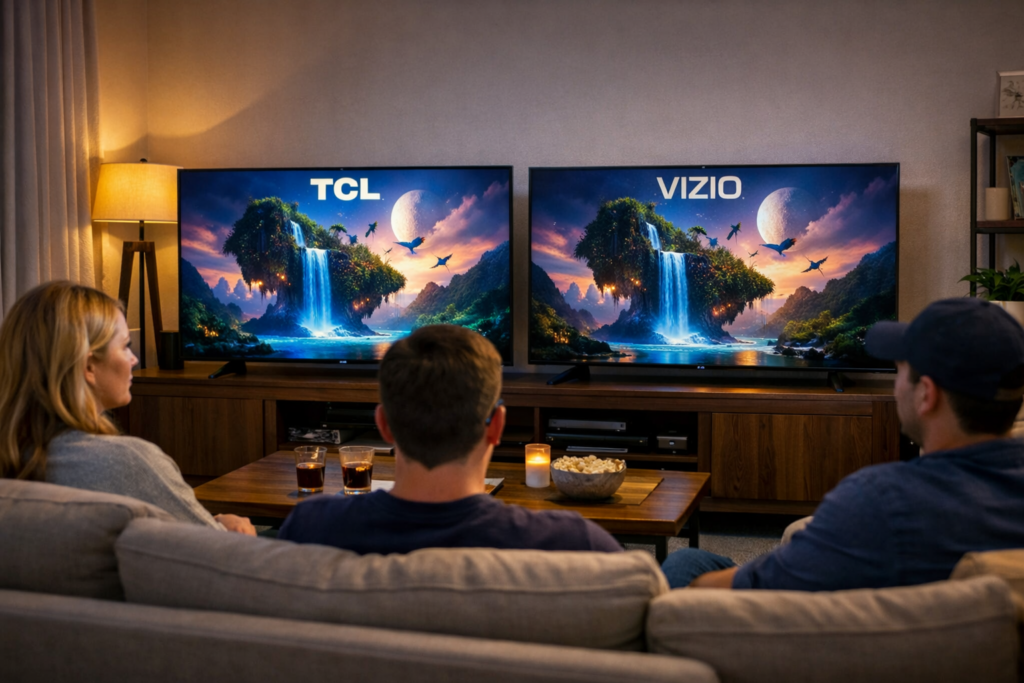
TCL vs Vizio: Direct Comparison
| Feature | TCL | Vizio | Notes |
|---|---|---|---|
| Panel Type | VA (mostly), some IPS in higher-end | VA (mostly), limited IPS | Both use VA for deep blacks; IPS for better angles is limited |
| Viewing Angle | Narrow to moderate | Narrow to moderate | Both brands have similar off-axis limitations |
| High-End Model Angles | TCL 6-Series offers better brightness, HDR | Vizio P-Series Quantum slightly better color saturation | Neither fully solves side viewing issues |
| Price vs Performance | Affordable midrange | Similar pricing | TCL often wins in value for picture quality at the price |
| Best For | Direct viewing, home theater setup | Direct viewing, central seating | For multiple viewers, consider TV placement or IPS models |
Summary: panels, or narrow viewing angles, are the main technology used by both TCL and Vizio. Higher-end versions with HDR and quantum-dot technology show some improvements, but neither brand is perfect for wide-angle viewing.
Tips to Improve Viewing Experience
You can enhance the overall experience even if a TV has limited viewing angles:
- Optimal Seating Placement
- For optimal photo quality, sit 25 to 30 degrees off-center.
- Steer clear of extreme side angles because the colors and contrast will deteriorate.
- Tilt and Mounting
- It can be beneficial to tilt the TV slightly in the direction of the main viewing area.
- Swivel wall mounts improve off-center viewing.
- Lighting Adjustments
- To lessen reflections that worsen side-angle color washout, dim the ambient lighting.
- Consider IPS Panels
- Look for TCL or Vizio models with IPS displays if wide-angle viewing is essential. Although they are uncommon in low-cost versions, some midrange sets do have them.
Alternatives for Better Viewing Angles
If viewing angles are your top priority:
- LG TVs: IPS panels, which provide outstanding off-axis performance, are used in the majority of LG TVs.
- Sony TVs: Wide-angle color consistency is maintained by certain Sony LED TVs with IPS screens.
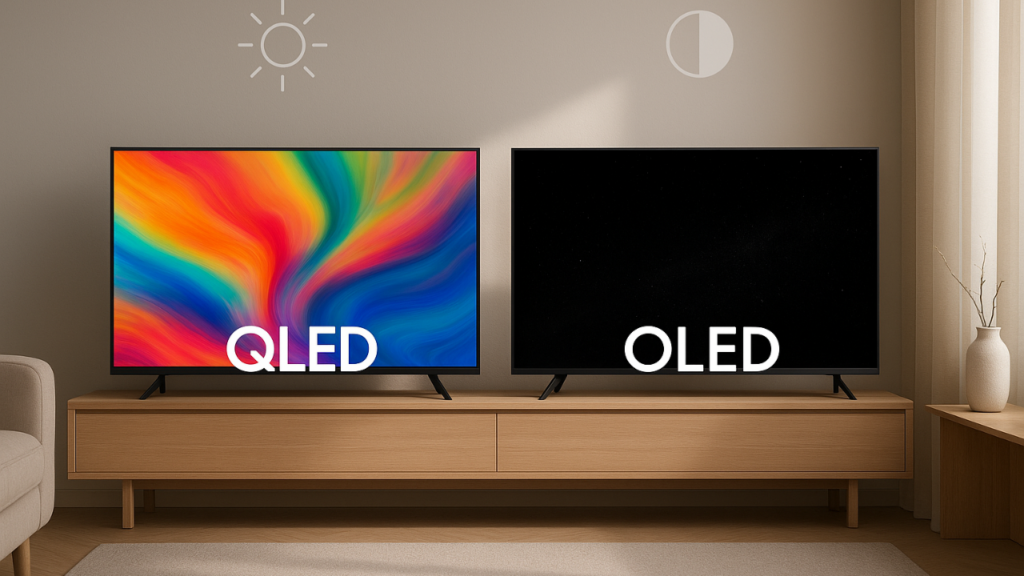
- OLED TVs: Because each pixel generates its own light, brands like LG OLED and Sony OLED offer almost ideal viewing angles.
These options may be more expensive, but they outperform the VA-based models from TCL and Vizio in terms of wide-angle performance.
Also Read About Is the Vizio V Series a Good TV? Honest Review + Pros & Cons
Conclusion
Here’s the bottom line if you’re choosing between TCL and Vizio based on viewing angles:
- VA panels, which restrict viewing angles, are the primary component used by both TCL and Vizio.
- Both brands have great direct front viewing, with vivid colors and deep blacks.
- Off-center viewing: Higher-end models with HDR or quantum-dot technology perform marginally better, although colors and contrast deteriorate for both.
- Suggestion: TCL or Vizio are good options for homes with a single or central viewing area. You could wish to think about IPS panel TVs or OLED alternatives if there are several viewers dispersed across the space.
In the end, viewing angle is only one factor to consider when purchasing a TV. In addition to panel technology, take into account your room’s layout, the number of viewers, brightness, HDR compatibility, and smart features. If wide-angle viewing is important to you, you may need to search a little further than TCL and Vizio, both of which provide great value.