
Best Television Viewing Angle
Do you know about Best Television Viewing Angle, if yes then this article is for you. We are discussing about it here. Read on for more.
Finding the ideal viewing angle for television might be crucial to getting the most out of your viewing experience. The ideal viewing angle will change depending on how your house is set up.
Generally speaking, the optimal viewing posture is the one where the line of sight is centered on the screen. However, this could change based on the size of your screen, the lighting in the area, and the TV itself.
You must first determine your eye height in order to obtain the optimal viewing angle. This will assist you in figuring out your TV’s ideal height.
Additionally, you should make sure that sitting at a high viewing angle does not cause neck pain. It will be much simpler to mount the TV on the wall if you can locate a comfortable height.
When selecting a TV for a large space, wide viewing angles are also crucial. Better picture quality and broader perspectives are provided by a TV with a wide viewing angle.
Another fantastic feature for those with lots of chairs in their living room is wide-angle viewing.
Additionally, a lot of TVs come with a high-definition panel that lets the user select the precise viewing angle.
The processor is another thing to think about. Your TV’s rendering of the image is controlled by the CPU.
Make sure the TV has a good processor if you want to get one with a broad viewing angle. In order to improve your viewing experience, you should also investigate the TV’s built-in sound system.
Also Read About Macbook Vs Gaming Laptop[2026]
Type of TV Has the Best Viewing Angle?
Knowing which kind of panel provides the finest viewing angle is crucial when looking for a new TV.
There are several types of panels on the market, including OLED, QLED, IPS, VA, and curved panels. Each has their own advantages and disadvantages. To help you decide, we’ve listed the pros and cons of each type of panel.
OLED
Of all the televisions available today, an OLED TV boasts the broadest viewing angle. Even though it might not seem like much, this can have a significant impact on how you watch television.
You should seek for an OLED TV if you are viewing it at an angle that limits the amount of information you can see.
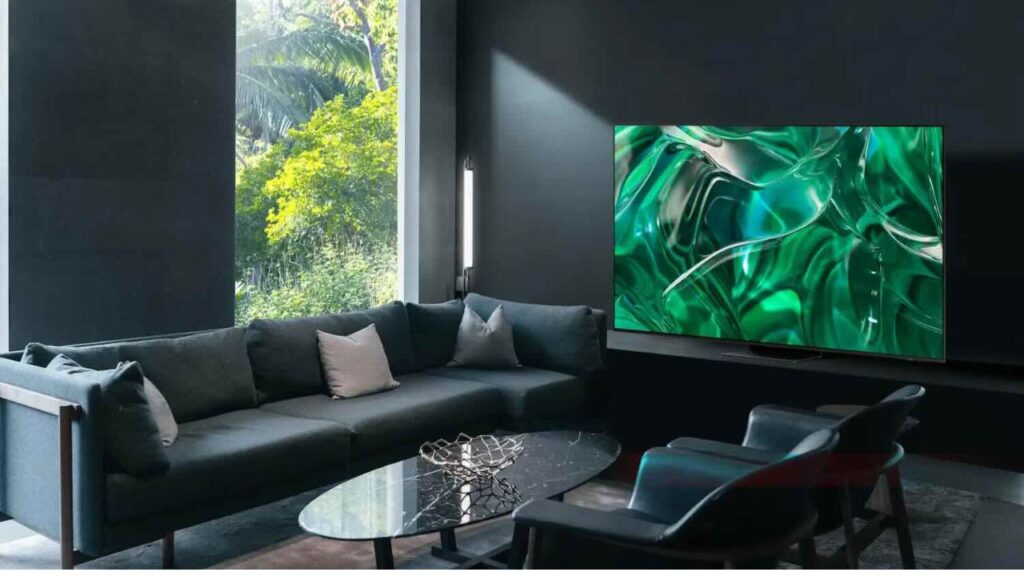
Although zero degrees is the ideal angle, most viewers don’t feel uncomfortable at even thirty degrees.
The viewing angle of an OLED TV is superior to that of an LED TV. LEDs perform best in the dead center, however depending on the model, picture quality deteriorates at the sides.
For instance, an LED TV with an IPS panel performs marginally better off-angle than an LED TV with a VA type panel. However, in the black level category, IPS panels typically perform poorly.
In contrast, Samsung’s QLED TVs perform noticeably better off-angle than its predecessors.
QLED
There are now two widely utilized technologies on the market for TV screens. One is OLED, while the other is QLED.
Both make displays using cutting-edge materials and technology. There are several significant distinctions between them in addition to their commonalities.
Quantum dots, which are microscopic particles that produce a vivid, colorful light, are used in QLED.
OLED TVs are ideal for group viewing because of their wide viewing angles. Their viewing angle is roughly 70 degrees from the center on average.
You can see the color variations while looking at it from the side.
A QLED TV, on the other hand, offers a viewing angle of 20 to 40 degrees. Although it isn’t nearly as fantastic as an OLED, it is still the greatest TV in terms of viewing angle.
IPS
There are many benefits to having an IPS TV. For one thing, it offers the best viewing angle, which is important if you intend to watch TV in a big room.
You will also get the best picture quality since it will not change based on the angle you watch the television from. Aside from that, IPS TVs also have a low cost and few cons, which is another plus.
The best viewing angle comes from the IPS panel, which is a form of LCD.
This type of panel offers the best contrast ratio, colour, and purity of black. It also has a higher refresh rate than TN panels.
VA
Viewing angle is a crucial consideration when determining whether to get a new TV. The broadest viewing angles are found on VA TVs. The viewing angles of IPS panels are smaller. However, VA TVs outperform IPS screens in terms of contrast ratios. However, you should be aware that IPS panels are better at displaying color variations than VA panels. They also respond slowly and have a limited color spectrum.
IPS panels can provide the best viewing angles, however the picture quality deteriorates at longer viewing distances.
Because IPS panels employ In-Plane Switching (IPS) technology, this is a benefit. By using this technique, the pixels can rotate in parallel and are aligned horizontally.
OLED TVs Have the Best Viewing Angle
An OLED display emits light rather than using a conventional backlight because it has an organic layer on its surface.
As a result, the design is smaller and more streamlined. A broader viewing angle is also made possible by this. Therefore, compared to traditional LCD displays, OLED TVs are more adaptable.
OLED TVs have a wide viewing angle
One of the best aspects of OLED TVs is their wide viewing angle. The colour accuracy of the picture does not vary much from side to side, even with a different angle of viewing.
Another great feature of OLED TVs is their self-luminous pixels, which drop annoying brightness and colour fluctuations.
They emit light with an organic layer
OLED TVs emit light with an organic layer, as the name implies. Visible light can pass through this layer of light.
The combination of an emitter and an active layer makes this technology useful. The optimal viewing angle is made possible by this combination.
They have better contrast ratios
In dimly lit spaces, a higher contrast ratio improves the viewing experience. However, under some circumstances, a lower contrast ratio is still sufficient.
The contrast ratios of various display types can fluctuate significantly depending on the backlighting technology employed.
A new OLED TV, for instance, can have a contrast ratio of over 4,000:1, whereas a transmissive digital projector can only have 200:1.
They have better black levels
OLED TVs are renowned for having superior black levels when compared to other screens. This is because OLED televisions have great viewing angles. They let you sit diagonally in front of the TV without changing the color or brightness.
However, reflections are a common problem with OLED TVs. This implies that object reflections are more common in gloomy situations.
They have low input lag
OLED TVs are perfect for games because of their low input lag. High input lag can make controllers feel mushy or lack urgency, so this is a crucial element for competitive gaming.
The great majority of LED TVs have little input lag and are designed for gamers.
They have quick response times
An essential component of a television’s visual performance is the pixel reaction time, or the amount of time it takes for a pixel to transition from black to white.
In fast-moving scenes, a quick response time reduces motion blur and artifacts. The response speed of OLED TVs is quite quick.
An OLED television can react in as little as 0.2 ms, compared to a standard LCD television’s 3.5 ms pixel reaction time.
Best Viewing Angle and Height
Mounting a TV at a pleasant viewing angle will provide maximum comfort and the greatest possible viewing experience. A television’s typical viewing angle ranges from 0 to 15 degrees.
Additionally, it is advised that televisions be installed at a height of at least 100 cm. Using movable brackets to tilt the screen forward is also a smart idea.
From the other side of the room, a 55-inch TV screen may appear small. Simply multiply the distance between the TV and the seating area by 0.84 to determine the appropriate TV size.
To get the greatest image, for instance, you should purchase a 60-inch television if the distance between your TV and the end of the seating area is 72 inches.
Make sure to put your TV at the optimal viewing angle if you want to maximize its picture quality.
A viewing angle of 30 degrees or less is advised by the Society of Motion Picture and Television Engineers.
However, when we sit casually, most of us don’t tilt our heads more than 10 to 15 degrees.
Try it out in your room before you buy a new TV. Placing it above your eye level will allow you to determine its height and viewing angle.
But keep in mind that the viewing angle you can appreciate without straining your neck is the optimum one.
Conclusion
The position where the line of sight is centered on the screen is ideal for viewing. However, this could change based on the size of your screen, the lighting in the area, and the TV itself.
You must first determine your eye height in order to obtain the optimal viewing angle. This will assist you in figuring out your TV’s ideal height.