
Best Material for Projector Screen
Did you know about Best Material for Projector Screen, if yes then this article is for you. We will be discussing. Read on for more.
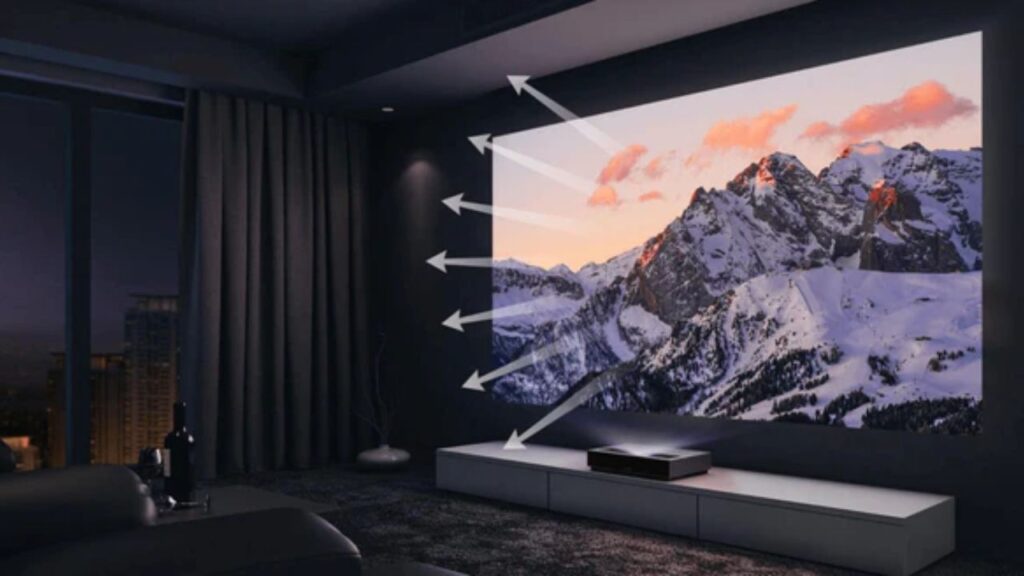
One of the most important choices when installing a projector is the type of screen material. Budget, indoor placement, aesthetics, and mechanics are just a few of the numerous things to think about.
The best approach to guarantee a clear image and a top-notch audiovisual experience is to use a screen that is positioned at the right height and distance from the wall. Additionally, the sound system’s bass distribution and reverberation benefit by leaving a small gap between the screen and the wall.
Additionally, it will protect the screen material from surface changes that could degrade the quality of the visual display.
Because uneven surfaces might provide unwelcome distractions, the wall’s surface should be level and flat. Although it’s not required, painting the wall is an option.
Another way to improve the movie image’s focus is to paint the wall a darker color. For improved viewing, you might also wish to think about a screen with reflecting qualities.
Woven material is an additional option for projector screen material. Compared to perforated screens, woven screens are more effective at letting sound through, but they will prevent light from doing so. Usually, this material is composed of sturdy PVC.
Also Read About Top 7 Best Cheap Drawing Tablet [2026]
What Features Make a Good Projector Screen?
When purchasing a projection screen, there are a number of crucial aspects to take into account.
The screen’s size must be taken into account first. The aspect ratio of the projection screen, which must coincide with the projector’s, will determine this. Take into account the screen’s substance as well. For some uses, some materials work better than others. For instance, you could want a screen that is both lightweight and sturdy.
Color integrity is a crucial component. The image on a computer screen should be as accurately reproduced as possible by good screen material. For example, you don’t want purple pixels on a green background.
You’ll get a poor image if the screen can’t accurately replicate the color of your display. Another crucial factor to take into account is color clarity. However, measuring this parameter is challenging.
Best Material for Projector Screen
There are numerous possibilities available if you’re searching for the best projector screen material. Stretchy screens, EPPE polymer, and blackout cloth are some of these choices.
However, what you want your home theater to do will determine which option is ideal.
For example, blackout cloth is incredibly robust and flat. Additionally, it will display movies flawlessly. It comes in a variety of sizes and is an inexpensive material.
Blackout cloth
Blackout fabric is a fantastic choice if you want a projector screen that is both aesthetically beautiful and glare-free. This kind of material can be hung without additional felt tape and has a solid black border.
It may be used for numerous other home projects and is compatible with the majority of projector screens. However, you should remember that the majority of projector screens require a material that is devoid of creases and wrinkles. Therefore, ironing your blackout cloth before hanging it is a smart idea.
Blackout cloth is a great choice if you’re on a tight budget. Purchasing it online or at a nearby hardware store is simple and reasonably priced. However, since there are numerous possibilities, make sure to examine the color of the material.
Use a white blackout cloth for optimal results. This will give you a stronger contrast and guarantee that your film looks as excellent as possible.
EPPE polymer
When choosing the appropriate material for a projector screen, there are numerous things to take into account. The projector screen’s price, position, functionality, and appearance must all be taken into account.
Maintaining a certain amount of distance between the screen and the wall is also crucial because it improves the quality of the image projection. Additionally, the area enables improved bass distribution and reverberation from the sound system. Installing a screen will require a few tools.
It’s crucial to read customer evaluations of the product before selecting a projector screen material to find out if prior consumers had any negative or great experiences.
In order to ensure that the product is safe to use, you should also seek for product certifications for the material. Additionally, seek for screen characteristics that will suit your demands and benefit you.
Stretchy screens
Compared to conventional screens, stretchy screens have fewer folds and are simpler to affix to a frame.
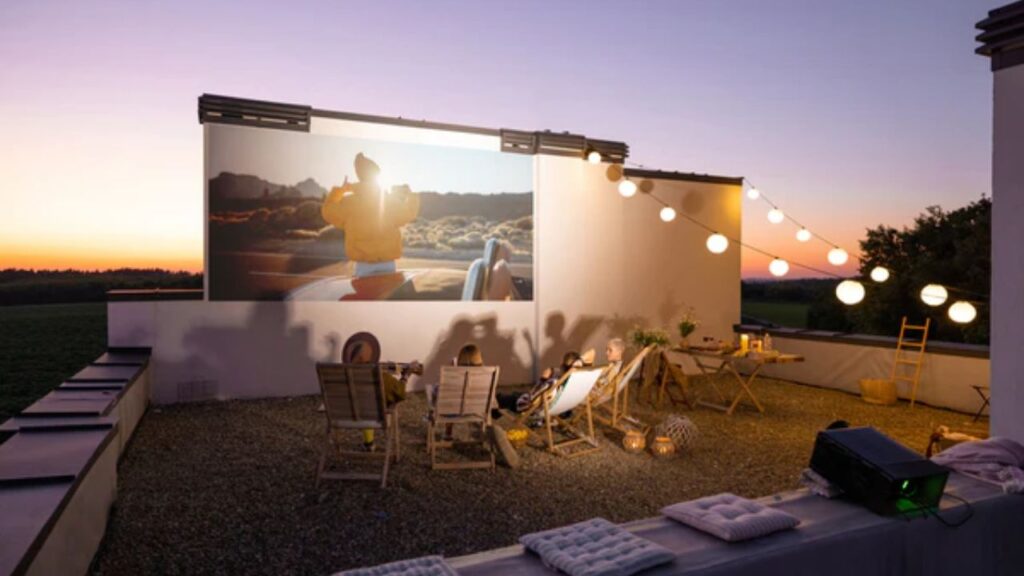
For portability, they may also be folded up and down. Outdoor projections can also be done with these screens. They are ideal for backyards and may be used both indoors and outside.
Make sure the material you choose for your projector screen is stretchable. For projection screens, a polyester blend cloth is a suitable choice because it will stretch with the projector.
Additionally, this kind of fabric is more consistent.
Although a drop cloth can be used for your screen, a canvas-like material is the ideal option. Select a color that complements the setting in which you plan to use the screen.
Bed sheets
Bed linens are probably your best option if you’re searching for a straightforward material to use as a projection screen. The sheets have neutral colors, are flat, and are quite light.
Light from the movie projector will pass through them due to their thinness, accentuating forms, colors, and patterns. However, be advised that using a bed sheet as a projection screen can degrade the quality of your movie projection.
Bed sheets are another excellent choice because they are affordable and adaptable.
A bed sheet can be used anywhere and is easily adaptable, in contrast to a typical screen. However, you should measure the area of the wall where the screen will be installed and ensure that it is as level as possible.
The quality of the projection will be impacted by the wall’s texture, thus it is advisable to select a level surface.
Tarps
An excellent projection screen is a camping tarp. However, it’s crucial to select the appropriate material for your specific projection screen.
An excessively flat tarp will result in poor image quality. Choosing a tarp with a solid construction, such as a wooden frame, would be a preferable option in this situation.
The most popular and least expensive material for a projection screen is white tarp. However, it’s crucial to remember that it won’t be the greatest option for huge commercial projects and expensive projectors. The glossy shine that white tarps frequently have will lower the quality of the image.
Additionally, you should select a cooler material that blends in with the surroundings.
A white sheet would be a better choice, but before hanging it, make sure it is free of wrinkles and bunching. To stop light bleed, you might also want to place something behind the screen.
Painting walls under a projector screen
To improve the quality of your projection, you might choose to paint the walls beneath your projector screen. You can use a paint specifically made for screens and projectors to paint the wall. You might wish to use primer before painting because it will take longer to dry.
For optimal video projection, the paint used to paint the walls beneath a projector screen should have a matte finish and reflect as little light as possible.
Paint On Screen S1 Ultimate Contrast, Digital Ultra White HD, and S1 Screen Plus Silver are ideal paints for the walls under a projector screen.
Will Using a Bed Sheet to Project on Work?
A cheap alternative for projection work is bed linens. Additionally, they feature materials with a larger thread count that can be employed to enhance image quality.
To enhance the quality of the photos, you should use a white, silky sheet with few creases.
A bed sheet can also be used as a drop cloth.
This can be used to cover furniture while painting. Your kids will be occupied for hours if you use it as a fort. You can use a bed sheet to cover the couch even if you’re not working on a big project.
An old bed sheet can also be used to create a bath mat or dusting cloth.
The bed sheet’s ease of washing makes it ideal for this duty. It is simple to clean your bed sheet if you spill something on it. The same method can be used to create a bath mat. You can make one by following the directions on the Common Thread website.
Making tablecloths and picnic blankets out of discarded bed linens is another fantastic use for them.
Because fitted sheets contain elastic to keep them from blowing around, they are excellent for this function. Additionally, you can follow the instructions at Craft Stylish to create a tote bag out of an old bed sheet.
Conclusion
This was our guide on Best Material for Projector Screen
Generally, it’s preferable to check the output with the screen using an example of the hardest-to-match image. However, the final decision should ultimately be based on personal preference.
The aspect ratio of the screen and the projector should coincide. This is crucial since using screens that are too small can result in hot spots, inconsistent contrast, and seams in your image.
If this article about the Best Material for Projector Screen was helpful to you, please let us know in the comments area.